
Melamine Foam vs. XPE Foam: Which Is Better for Acoustic and Thermal Insulation?
Understanding the differences between open-cell melamine foam and closed-cell cross-linked polyethylene foam — and when combining both materials offers a more practical insulation solution.
Selecting the right foam material is an important part of industrial equipment design. Acoustic absorption, thermal insulation, moisture exposure, mechanical durability, fire performance and installation requirements all influence material selection.
Two materials frequently considered for industrial insulation applications are melamine foam (MF) cross-linked polyethylene foam (XPE).
Although both are lightweight cellular materials, their structures and functional properties are significantly different.
Melamine foam is valued for its open-cell acoustic absorption, low density, thermal insulation and inherent flame-resistant characteristics. XPE foam is known for its closed-cell construction, flexibility, cushioning, low water absorption and ease of fabrication.
Neither material is universally better. The right choice depends on the operating environment and the engineering requirements of the finished component.
In applications requiring both acoustic absorption and flexible mechanical backing, melamine foam–XPE composite materials provide an additional design option.
- 멜라민 폼이란 무엇인가요?
Melamine foam is a lightweight, open-cell thermoset foam produced from melamine resin.
Its structure consists of an interconnected three-dimensional network of fine cellular elements. This structure allows sound waves to enter the material and lose energy through viscous and thermal interactions within the pores.

The open-cell architecture is central to its sound absorption performance.
Melamine foam is commonly used in:
- 산업용 방음 인클로저
- 냉난방 및 환기 장비
- 자동차 방음재
- Machinery and compressor housings
- Building acoustic treatments
- Transportation insulation components
- Specialized thermal insulation systems
Key Advantages of Melamine Foam
Effective acoustic absorption
The open-cell structure enables sound energy to penetrate the material, making melamine foam suitable for controlling reflected sound and reducing reverberation in appropriately designed enclosures.
매우 낮은 밀도
Melamine foam is available in lightweight grades, making it attractive for applications where mass reduction is important.
단열재
Its fine cellular network provides resistance to heat transfer, supporting applications requiring both thermal and acoustic functions.
Favorable fire performance
Melamine foam can offer favorable flame resistance compared with many conventional polymer foams. Actual classifications depend on the grade, thickness and applicable test method.
온도 저항
Selected melamine foam grades can operate at temperatures beyond the normal service range of polyethylene-based foams. The permissible temperature must always be confirmed for the specific material grade.
Limitations of Melamine Foam
Despite its advantages, melamine foam has several characteristics that must be considered in engineering designs.
Its open-cell structure can absorb water unless the material has been specially treated. Its low-density cellular network can also be vulnerable to tearing, abrasion and local mechanical damage.
In applications involving repeated handling, complex installation or significant compression, additional support or protective layers may be beneficial.
- What Is XPE Foam?
XPE, or cross-linked polyethylene foam, is a closed-cell polymer foam manufactured from polyethylene using a chemical cross-linking process.
Cross-linking modifies the polymer network, allowing manufacturers to produce flexible cellular materials with different densities, thicknesses and mechanical characteristics.
XPE is widely used in automotive interiors, HVAC insulation, packaging, industrial cushioning, seals and building products.
Key Advantages of XPE Foam
낮은 흡수성
Its predominantly closed-cell structure helps limit water penetration through the foam body, making XPE useful in moisture-resistant insulation and cushioning applications.
Flexibility and cushioning
XPE accommodates bending and compression and can provide an elastic interface between components.
Good fabrication characteristics
XPE sheets can be converted into die-cut parts, gaskets, liners and laminated products.
단열재
The closed-cell structure provides useful thermal resistance in applications operating within the material’s specified temperature range.
기계적 지원
Compared with very low-density melamine foam, selected XPE grades can provide better resistance to handling damage and localized compression.
Limitations of XPE Foam
The main limitation of conventional XPE in acoustic applications is its closed-cell structure.
Unlike open-cell acoustic absorbers, XPE generally does not allow sound waves to penetrate deeply into its cellular network.
It can support vibration isolation, sealing and certain noise-control functions, but it should not automatically be considered a replacement for a dedicated porous sound absorber.
XPE also has temperature and fire-performance limitations. Conventional polyethylene foams can soften, deform or burn under unsuitable conditions.
Flame-retardant grades are available, but their performance must be verified against the relevant application requirements.
- Melamine Foam vs. XPE Foam: Technical Comparison
The following comparison summarizes the principal differences between the two material families.
| 부동산 | Melamine Foam (MF) | XPE 폼 |
| 폴리머 유형 | Melamine resin, thermoset | 가교 폴리에틸렌 |
| 세포 구조 | 개방형 셀 | 주로 폐쇄 셀 |
| Primary acoustic function | 흡음 | Cushioning, sealing and vibration decoupling |
| 단열재 | 좋은 | Good within specified service conditions |
| 물 흡수 | Generally higher unless treated | 일반적으로 낮음 |
| 유연성 | Flexible but can be fragile | 유연하고 탄력적 |
| 취급 내구성 | Requires care in low-density grades | Often better suited to handling and die-cutting |
| 화재 행동 | Favorable in selected grades | Depends strongly on formulation and flame-retardant package |
| 온도 저항 | Higher in selected grades | Typically more limited |
| 일반적인 애플리케이션 | Acoustic absorbers and thermal insulation | Cushioning, gaskets, backing and insulation |
중요 사항: These are general material characteristics, not certified performance specifications for every grade.
Engineers should evaluate supplier technical data sheets, test reports and the finished component before making a final selection.
- Which Material Is Better for Sound Absorption?
For conventional porous sound absorption, melamine foam is generally the more suitable material.
When sound waves reach an exposed melamine foam surface, acoustic energy can enter the interconnected pores. Internal friction and thermal interactions dissipate part of that energy.
This makes melamine foam useful in industrial acoustic enclosures, HVAC units and other applications where reflected noise needs to be controlled.
XPE performs differently.
Its closed-cell structure limits the penetration of airborne sound into the foam. Consequently, a conventional XPE sheet is not normally the preferred primary absorber for an enclosure requiring broadband porous sound absorption.
However, XPE may be useful as a resilient layer, mechanical spacer or sealing component in a complete noise-control assembly.
Sound Absorption Is Not the Same as Sound Insulation
이 차이점은 중요합니다.
흡음 reduces reflected acoustic energy within a space or enclosure.
방음 concerns how much sound passes through a separating structure.
A lightweight porous foam may provide effective absorption without offering high transmission loss on its own.
Where substantial sound blocking is required, designers may need a separate high-mass barrier, a sealed enclosure or a properly engineered multilayer system.
- Which Material Is Better for Thermal Insulation?
Both melamine foam and XPE foam can provide thermal insulation, but their suitability depends on the operating conditions.
Melamine foam is particularly useful where low weight, acoustic absorption and elevated-temperature resistance are required simultaneously.
XPE is attractive for moderate-temperature applications requiring insulation together with flexibility, cushioning or moisture resistance.
For example, XPE is commonly considered for HVAC insulation, equipment liners and other components where surface contact and dimensional flexibility matter.
When evaluating thermal insulation, the most important parameters include:
- Thermal conductivity at the relevant temperature
- 재료 두께
- 서비스 온도
- 수분 노출
- Compression and installation conditions
- 장기 치수 안정성
A multilayer construction can provide additional thermal resistance, but its actual performance must be evaluated as an assembly.
- When Should Engineers Choose Melamine Foam?
Melamine foam should generally be considered when the application prioritizes:
흡음
Industrial enclosures, ventilation equipment and machinery housings requiring porous acoustic treatment.
낮은 부품 무게
Transportation and equipment applications where lightweight insulation is important.
더 높은 작동 온도
Areas in which conventional polyethylene foam may not meet thermal requirements.
화재 성능 요구 사항
Projects that benefit from the characteristics of a suitable melamine foam grade, subject to the applicable certification.
Pure melamine foam may also be preferable where additional laminate layers would create unnecessary cost, mass or fire-performance complexity.
- When Should Engineers Choose XPE Foam?
XPE is often more suitable when the application primarily requires:
쿠션 및 충격 보호
Equipment components, protective inserts and resilient backing materials.
습기 방지 단열재
Closed-cell insulation for suitable HVAC, appliance and industrial applications.
Flexible die-cut components
Custom gaskets, equipment liners, pads and installation spacers.
기계적 분리
Resilient interfaces designed to reduce direct contact between components.
For applications focused mainly on sealing, cushioning or moisture resistance, adding melamine foam may provide limited additional value.
The material selection should follow the functional requirement rather than simply increasing the number of layers.
- Why Combine Melamine Foam with XPE?
In some industrial applications, neither material alone addresses all design requirements.
Melamine foam provides the acoustic absorption layer, while XPE offers a flexible backing that may improve handling, cushioning and installation compatibility.
A typical composite concept consists of:
Open-cell Melamine Foam + Lamination Interface + Closed-cell XPE Backing
The melamine foam layer can face the sound source, while the XPE layer faces the supporting substrate.
This arrangement allows the exposed melamine foam surface to perform its primary acoustic function.
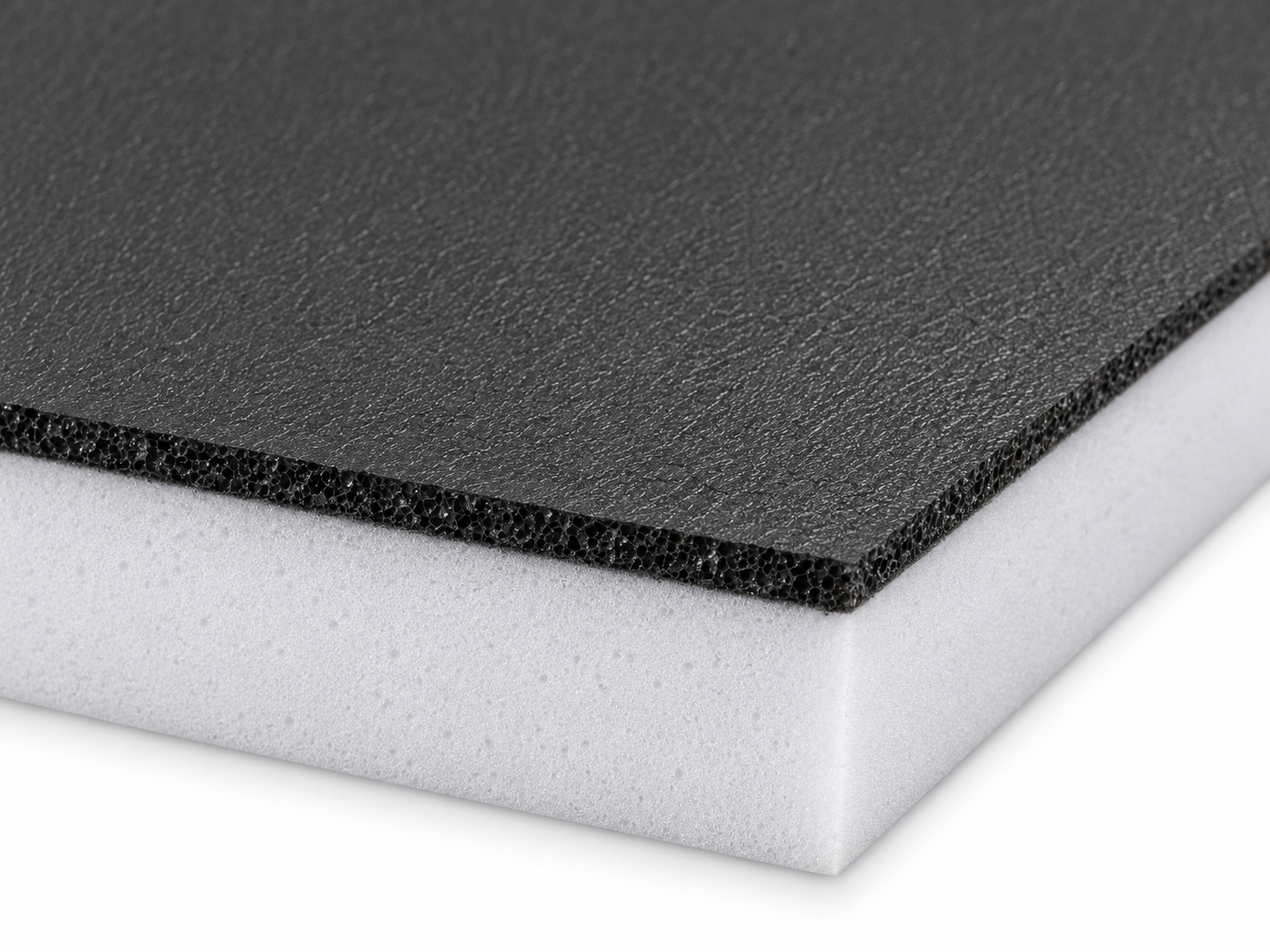
Potential Benefits of MF–XPE Composite Materials
- Integrated acoustic and thermal functions
The composite combines a porous acoustic absorber with an additional thermal insulation and backing layer.
- 향상된 핸들링 특성
The XPE backing can support low-density melamine foam during cutting, transportation and installation.
- Moisture-resistant backing
The closed-cell XPE layer may help restrict moisture migration from the substrate side.
It does not make the exposed melamine foam layer waterproof.
- 맞춤형 제조 유연성
Composite sheets can be developed into adhesive-backed panels, equipment liners and precision die-cut parts.
- Application-specific material design
Different MF and XPE thicknesses can be evaluated to balance acoustic performance, thermal resistance, weight and mechanical requirements.
What Are the Limitations of MF–XPE Composites?
The composite does not automatically outperform pure melamine foam in every property.
Adding XPE increases material weight and introduces additional temperature and flammability considerations.
The adhesive layer also affects overall durability and may influence acoustic performance if the lamination process obstructs the open-cell structure.
Therefore, final composite performance must be evaluated through relevant testing.
- Industrial Applications of MF–XPE Composite Panels
Industrial Machinery and Compressor Enclosures
Air compressors, industrial fans, pumps and machinery housings may require both acoustic absorption and convenient installation against metal panels.
MF–XPE composites can be evaluated as enclosure liners and custom-cut insulation components.
The melamine foam layer absorbs reflected sound, while the XPE layer provides flexible backing and installation support.
HVAC and Heat Pump Equipment
Air handling units, heat pumps and chillers frequently combine noise-control and thermal insulation requirements.
MF–XPE composites offer an approach to integrating porous sound absorption with flexible insulation backing in suitable enclosure locations.
Designers should account for air movement, moisture, hygiene, operating temperature and relevant fire requirements.
Automotive Interior NVH Components
Dashboard insulation, door trim backing, roof liners and selected commercial vehicle interior components may benefit from combining acoustic absorption with flexible backing.
The composite can be evaluated for custom die-cut NVH applications, subject to vehicle-specific flammability, emissions, odor and durability requirements.
Appliance and Refrigeration Equipment
Commercial refrigeration units, washing machines and other appliances may benefit from acoustic liners that also support thermal insulation and installation flexibility.
The exact construction should be selected according to the enclosure geometry, component temperatures and noise characteristics.
Custom Industrial Acoustic Panels
MF–XPE composites can also be developed into removable acoustic liners, adhesive-backed panels and precut components for industrial equipment manufacturers.
These configurations may reduce the number of separate materials handled during assembly, depending on the customer’s manufacturing process.
- How to Select the Right Foam Construction
Before selecting pure MF, pure XPE or an MF–XPE composite, engineers should establish the following requirements.
음향 요구사항: What frequencies need to be controlled? Is the main objective absorption, vibration decoupling or transmission loss?
열 요구 사항: What are the continuous operating temperature, peak temperature and target thermal resistance?
기계적 요구 사항: Will the material be compressed, bent, removed repeatedly or exposed to abrasion?
환경 조건 : Is the application exposed to moisture, oils, cleaning chemicals or outdoor conditions?
Fire and regulatory requirements: Which standards must the finished component meet?
설치 조건 : Will the material be mechanically fixed, laminated, adhesive-backed or die-cut to shape?
상업적 요구사항: What are the target thickness, mass, cost and annual purchase volume?
These parameters help determine whether the additional functions of a composite justify its cost and complexity.
- SINOYQX Melamine Foam–XPE Composite Solutions
SINOYQX offers melamine foam materials and develops application-oriented composite solutions for industrial acoustic and thermal insulation requirements.
Its MF–XPE composite combines the open-cell acoustic characteristics of melamine foam with the flexibility, cushioning and moisture-resistant backing properties of cross-linked polyethylene foam.
Depending on project requirements, development options may include:
- Different melamine foam grades and densities
- Customized XPE backing thicknesses
- Laminated sheets and panels
- Precision die-cut insulation components
- Application-specific dimensions
- Adhesive-backed constructions subject to evaluation
The appropriate material configuration depends on the customer’s acoustic, thermal, mechanical and regulatory requirements.
For information about the composite material concept, see:
자주 묻는 질문
Is melamine foam better than XPE foam for sound absorption?
For conventional porous acoustic absorption, melamine foam is generally more suitable because its open-cell structure allows airborne sound energy to enter the foam. XPE is more commonly selected for cushioning, sealing, thermal insulation and resilient backing.
Is XPE foam waterproof?
XPE has a closed-cell structure and generally exhibits low water absorption. However, its water resistance does not guarantee waterproof performance for a complete installed assembly, particularly at seams, joints and cut edges.
Can melamine foam and XPE foam be laminated together?
Yes. The materials can be combined in a laminated construction using a suitable bonding process. The adhesive system, interface preparation and lamination conditions must be compatible with both materials.
Does combining melamine foam with XPE improve acoustic performance?
Not necessarily. A composite can offer additional mechanical, thermal and installation functions, but its sound absorption performance depends on layer thickness, orientation, bonding and mounting conditions. Comparative acoustic testing is necessary.
Can MF–XPE composite foam withstand 200°C?
The complete composite cannot be rated according to melamine foam alone. XPE and the bonding system may have significantly lower temperature limits. The allowable operating temperature must be established for the finished construction.
Is MF–XPE composite suitable for automotive applications?
It can be evaluated for automotive interior acoustic and insulation components. The finished material must meet the relevant vehicle manufacturer’s requirements for flammability, emissions, durability and other applicable performance criteria.
Conclusion: Which Foam Should You Choose?
Melamine foam and XPE foam are complementary materials rather than direct substitutes.
Choose melamine foam when acoustic absorption, low density, thermal insulation and elevated-temperature performance are key requirements.
Choose XPE foam when cushioning, flexibility, moisture resistance and mechanical backing are the principal priorities.
Consider MF–XPE composite foam when an application requires a combination of acoustic absorption, thermal insulation and flexible backing within one engineered component.
The best construction depends on the application, and the completed laminate should always be evaluated against the relevant operating and safety requirements.
Explore SINOYQX Composite Insulation Solutions
For customized melamine foam–XPE composite panels, material selection assistance or sample evaluation, contact our technical sales team.
웹사이트: https://www.sinoyqx.com/
SINOYQX 소개
SINOYQX supplies melamine foam materials and application-oriented solutions for acoustic insulation, thermal insulation, industrial equipment and specialized foam applications. Its material portfolio supports manufacturers and converters seeking lightweight, functional insulation solutions.